Stop rebuilding what your firm knows.

Your data records what happened, the context layer knows what it means. It sits between your firm's data and the people, AI agents and models that use it, and keeps each decision with its date and source.

Take it apart

4 bn €1

a year lost by European firms of 10 to 500 consultants, recreating information that already exists

104 hoursa year per consultantEvery consultantof European firms of 10 to 500Hourly labour costacross Europe

A mission's context lives in pieces

A mission's context is everything the AI needs to know about it: who is involved, what was decided, why, and what changed.

The scope is decided in a meeting, the format sent by email, the milestones kept in a project tool. Why each one matters stays in one consultant's head.

Every AI question starts from zero and rebuilds that context. Miss one email, and the answer runs on last week's scope.

  • Meetingsthe decisions
  • Mailthe formats and approvals
  • Project toolsthe milestones
  • Shared filesthe state of the work
  • Staffing toolwho is on the mission
  • The consultant's headwhy it all matters

The context layer connects to your firm's databases and tools, and reads the documents that already exist.
One decision, five labels

An AI needs more than a sentence in an email. The context layer adds five labels as each decision enters.

  • Meaning

    What the decision is about, and what it conditions next.

  • People

    Who decided it, and with what authority.

  • Time

    When it became true, and when it stopped.

  • Provenance

    Where it comes from, a meeting, an email or a file.

  • Governance

    Who validated it, and who may read it.

A fact carries these five labels, or an agent treats a rumour and a decision alike.

Four dimensions of mission context

Where your firm's systems record outcomes, the context layer keeps their meaning in four dimensions.

  1. Relationships

    Who and what the mission connects, the client, the sponsor and the team.

  2. Firm rules and methods

    How the firm works, its templates and standards, applied by the skills of the Workspace.

  3. Work history

    What the mission did and decided, dated. The AI proposes each entry, the consultant ticks it.

  4. Temporal context

    What was true, and until when. An old scope stays, struck through and dated.

The scope

France onlyuntil 21 September

France and Belgiumfrom 21 September

The team and its AI, one source

Each firm has one context layer, and the whole team, people and AI, works from the same source on every mission.

  • The consultant

    Opens the mission where the last session stopped.

  • AI agents and models

    Prepare the steering committee from the milestones, and ask for what is missing.

  • Bekames Workspace

    Holds the mission and every dated decision, the same for the whole team.

  • Bekames Workflows

    Builds the steering committee deck from the objectives and the current scope.

Before each email or deliverable, the AI checks it against the current scope. The model keeps its limits, and the Workspace answers each one.

What blocks AI on a missionWhat the Workspace builds
It forgetsThe mission is kept from one session to the next
It makes facts upEvery fact is dated, sourced and ticked by a consultant
Every request costs moneyEach task goes to the right model, paid from the seat's Crédits
It follows instructions hidden in a documentOutside documents are read only, behind a boundary against hidden instructions
It locks the firm to one vendorThe mission lives in open files that any model reads

Context kept current, session by session

Context goes stale the day after it is written, and nobody owns its upkeep. At the end of each session, the AI proposes what to keep and the consultant ticks it.

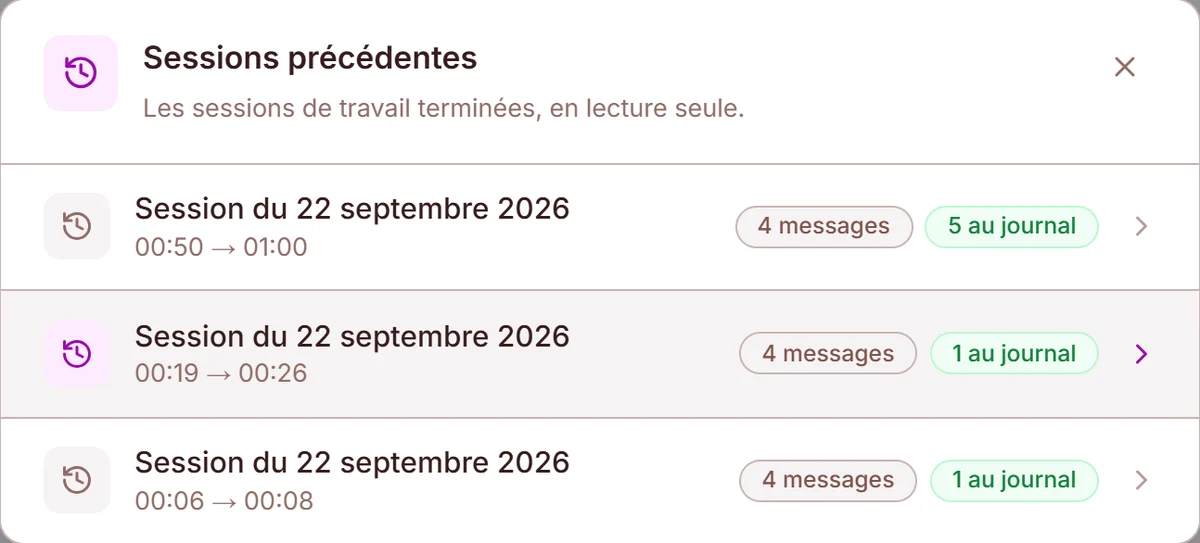
Three sessions, seven new log entries, the corrected scope among them. Coherence agents check each entry against the rest of the context, send only the conflicts back to the consultant and spot a decision replaced without anyone reporting it.

Most firms practise knowledge management after a mission, as archives. The context layer is knowledge management carried out during the mission, so the next session starts from the corrected scope.

The Workspace, the Halden mission's previous sessions: three sessions on 22 September, which sent five, one and one entries to the log.

The mission, in open files

The mission's context lives in six open files any model reads, from the mission sheet to the risks. The firm exports it whenever it wants.

Bekames, the sovereign, isolated and auditable platform

Your space is hosted in Europe and every action is traced. No model keeps your data or trains on it.

Read the security page
  • GDPRDesigned to comply
  • AI ActDesigned to comply
  • ISO 42001Designed to comply
  • SecNumCloudFranceCarried by our host
  • SOC 2 Type IIAfter the seed
  • ISO 27001Planned

What firms ask about the context layer

Another question? Write to contact@bekames.com.

What does the consultant have to do?

The consultant answers five questions at kickoff, and the AI drafts the mission's context, filed by subject. At the end of each session, the consultant ticks the log entries the AI proposes.

Who owns the context layer?

The firm. It is built from the firm's own data, and the firm exports it whenever it wants.

How is it different from an assistant's memory?

An assistant's memory keeps what it knows of one user, across that user's conversations. The context layer keeps the state of the firm's work for the whole team, each fact dated and ticked, readable by any allowed model.

How is it different from search (RAG)?

Search finds passages in documents at the moment a question is asked. The context layer keeps the state of the mission between questions, its objectives, its decisions and their dates.

Where does the mission's data live?

In your firm's sealed space in the EU, on your cloud or ours. No model keeps it or trains on it.

Which models read it?

The models the firm allows, with models hosted in Europe by default.

What happens when the mission ends?

The mission exports as open files owned by the firm, which sets its own retention and deletion policies. The method and the knowledge stay in the Workspace when a consultant leaves.

Sources

  1. Bekames estimate: consultants of European firms of 10 to 500 × 104 hours a year (APQC, 2021) × Eurostat hourly labour cost (2022)

Join the waiting list